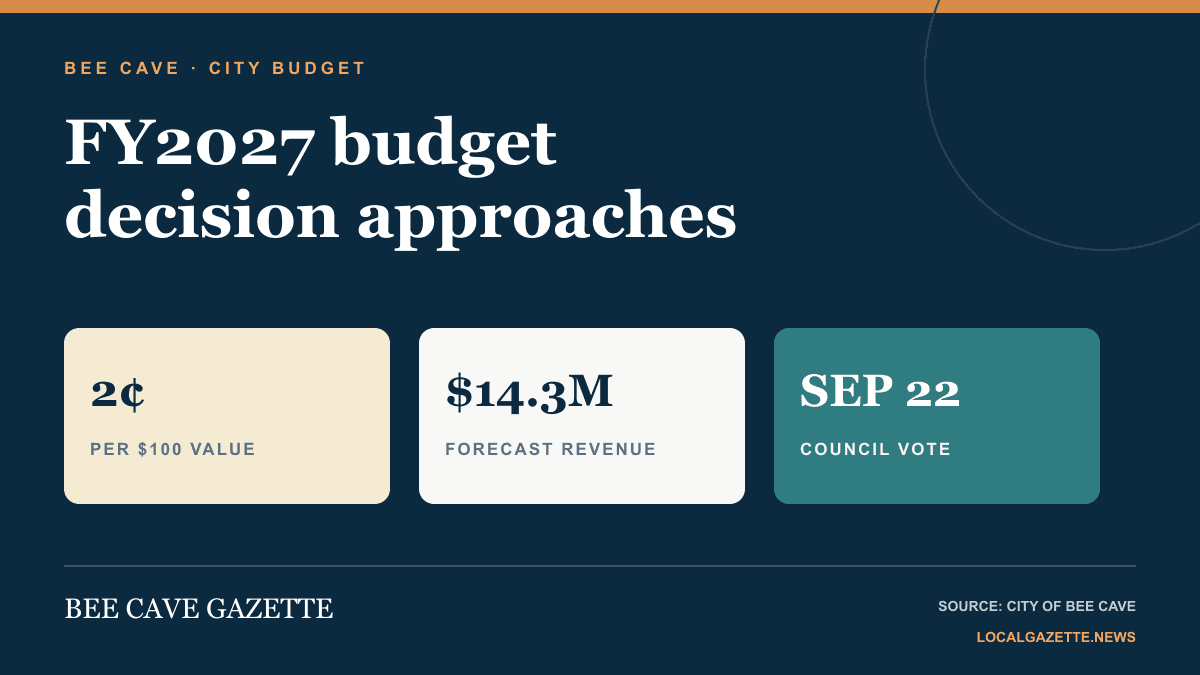
Bee Cave City Council is scheduled to vote September 22 on a proposed 2027 budget that keeps the municipal property-tax rate at two cents for every $100 of taxable value.
The city estimates that rate would produce an annual Bee Cave tax of about $153 for an average homeowner. That is the city's estimate for its own levy, not a prediction for the complete property-tax bill, which also includes other taxing bodies.
The proposal forecasts $14.3 million in general-fund revenue and $12.7 million in expenses. The city says the difference would be transferred to its capital fund, which is being used to pay for a new public-safety building.
What a flat tax rate means
Keeping the rate at two cents does not necessarily freeze the amount paid by every owner. A tax bill depends on taxable value after applicable exemptions as well as the adopted rate. If an appraisal changes, the city portion can change even when the rate does not.
Residents comparing years should use the taxable value shown on their own records and separate the Bee Cave levy from school, county and other district charges. The city's taxpayer-impact material provides its assumptions, but an individual calculation can differ from the stated average.
Bee Cave says sales tax funds most operating costs and that the city maintains a healthy reserve. Heavy reliance on sales tax makes retail activity important to the forecast, so readers should look at both the revenue estimate and what happens if collections are below plan.
Services and capital spending
The city says the budget continues investment in roads, parks, libraries and other quality-of-life services. Those broad descriptions should be read alongside the detailed proposed budget, where residents can compare departmental spending, staffing, transfers and capital projects.
The planned general-fund surplus is not described as spare cash for unrestricted new spending. The proposal directs it to the capital fund for the public-safety building. Capital transfers and day-to-day operating costs should therefore be compared separately.
Useful questions include how much of each forecast is recurring, which projects depend on one-time money, what reserve target the city uses and how the public-safety-building schedule affects later budgets.
How residents can follow the decision
The city advertised public-comment opportunities at council meetings on August 25, September 8 and September 22. The final listed vote is September 22, with the new financial year beginning October 1.
Anyone planning to speak should check the current agenda for the meeting time, location and sign-up rules. Written documents can also change between a proposed budget and adoption, so the final ordinance and adopted budget will be the controlling records.
The city's page links the budget calendar, taxpayer-impact statement, hearing notices and complete proposal. Those primary documents are the best place to check line items rather than relying only on a headline about “no new taxes.”
After the vote, residents should compare the adopted rate, final revenue assumptions and approved transfers with this proposal. A council vote can amend individual lines, so the pre-vote document should not be mistaken for the final financial plan.
Figures and hearing information are available on the official City of Bee Cave proposed-budget page.